For a long time, the dominant narrative in AI art generation was that achieving "photorealism" required spamming the prompt engine with generic descriptors like "hyperrealistic," "photorealistic," "8K," "highly detailed," or "octane render." With the release of Midjourney v6, and subsequent advancements in v7 and v8, this paradigm has been completely dismantled. Today, Midjourney's neural network has shifted toward natural language processing and physically based rendering (PBR) systems. Buzzwords are not only ignored; they can actively degrade image structure, resulting in artificial-looking, over-processed renders.
To generate images that are visually indistinguishable from real photographs across Midjourney v6, v7, and v8, you must communicate with the AI using the vocabulary of a real-world photographer. This means understanding and prompting physical lighting types, camera bodies, sensor dimensions, lens focal lengths, aperture mechanics, film stocks, and advanced engine parameters. This masterclass contains everything you need to know, complete with 20+ copy-paste prompts, parameter guides, and a comprehensive lighting cheatsheet.
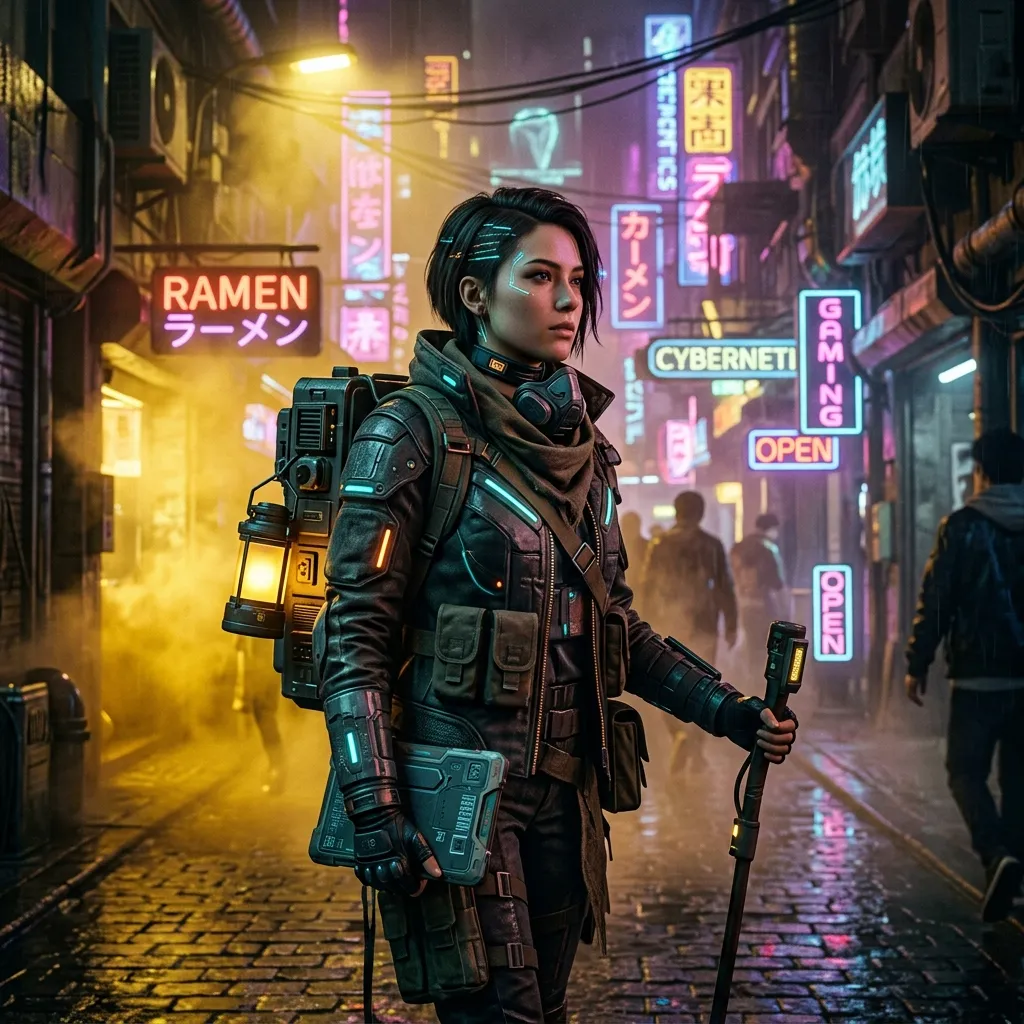
[IMAGE REFERENCE: blogimage/midjourney-lighting.webp - The cyberpunk traveler in a rain-slicked Tokyo alleyway demonstrates realistic volumetric fog, shallow depth of field, and rich neon chromatic casts.]
The Paradigm Shift: Midjourney v6 vs. v7 vs. v8
Each iteration of the Midjourney model brings unique changes in how it interprets photorealism:
- Midjourney v6: Introduced strict literal prompting. Natural language structure is highly respected. It has a high-fidelity rendering engine that excels at micro-textures, skin pores, fabric weaves, and glass reflections.
- Midjourney v7: Refines spatial composition and object interaction. It removes "AI haloing" (weird glows around subjects) and models light bounce (refraction, subsurface scattering) more accurately. Prompting in v7 requires fewer style modifiers, as the model understands camera placement naturally.
- Midjourney v8: Integrates a true physically based camera simulator. In v8, prompting "f/1.4 aperture" yields an accurate, natural falloff of focus (bokeh) rather than a synthesized filter blur. Similarly, it models ISO noise and lens imperfections, making it the most realistic model to date.
1. The Ultimate Lighting Reference Dictionary (20+ Terms)
Light is the single most critical factor in photography. It defines form, establishes depth, dictates contrast, and controls the color temperature of your scene. To get high-quality outputs, replace words like "beautiful light" with terms from this comprehensive reference dictionary:
| Lighting Type | Visual Description | Prompt Keyword/Phrase |
|---|---|---|
| Volumetric Light | Beams of light scattering through air particles (dust, fog, smoke). | "volumetric light beams," "crepuscular rays" |
| Rembrandt Lighting | Studio setup creating a signature light triangle under the eye on the shadow side. | "Rembrandt lighting," "chiaroscuro studio portrait" |
| Golden Hour | Soft, warm, low-angle natural light occurring shortly after sunrise or before sunset. | "golden hour light," "late afternoon sun, warm glow" |
| Blue Hour | Cool, deep-blue atmospheric lighting occurring shortly after sunset or before sunrise. | "blue hour, ambient twilight, cool tone" |
| High-Key Lighting | Bright, low-contrast lighting dominated by whites and soft shadows. Professional look. | "high-key studio lighting, bright commercial setup" |
| Low-Key Lighting | Dark, high-contrast lighting dominated by deep shadows and stark highlights. | "low-key lighting, dark moody shadows, high contrast" |
| Split Lighting | Light source placed at 90 degrees to subject, bisecting the face into half-light, half-shadow. | "split lighting setup, dramatic lateral key light" |
| Butterfly Lighting | Light placed directly above and behind camera, creating a butterfly shadow under the nose. | "paramount lighting, butterfly shadow, glamour lighting" |
| Rim Lighting | Backlighting that illuminates the outer edges of the subject, separating them from dark backgrounds. | "rim light, halo backlight, edge lighting" |
| Softbox Studio | Highly diffused light source creating soft shadows, smooth skin tones, and gentle highlights. | "large softbox illumination, soft studio light, diffuse fill" |
| Hard Sunlight | Direct, unfiltered sunlight creating harsh, high-contrast shadows. Typical for mid-day. | "harsh direct midday sun, hard shadows, high contrast sunlight" |
| Dappled Light | Sunlight filtered through an overhead grid, such as leaves, branches, or window blinds. | "dappled light, sunlight filtering through foliage, leaf shadows" |
| Cinestill Halation | Glow effect where bright red/orange rings appear around light sources, mimicking movie film. | "Cinestill 800t halation, red glowing highlights around streetlights" |
| Fluorescent light | Sterile, flat overhead light typical of offices or subways, often with a slight green tint. | "harsh fluorescent overhead lighting, green-tinted cast" |
| Candlelight | Warm, flickering light from a single low-intensity flame, creating organic skin reflections. | "warm candlelight, single candle source, high dynamic range shadows" |
| Bioluminescent Glow | Organic, self-emissive lighting from biological sources (e.g., fungi, deep sea creatures). | "bioluminescent soft blue glow, organic glowing particles" |
| Ring Light | Circular front-on lighting that creates circular reflection rings in the pupil. | "ring light catchlights in pupils, flat portrait beauty illumination" |
| Strobe Light | Ultra-fast, high-power flash that freezes fast motion, typical in high-fashion shoots. | "strobe light flash, high-speed shutter freeze, bright white pop" |
| Moonlight | Cool, slightly desaturated overhead light, casting deep blue and silver shadows. | "moonlit night sky, cool silver moonlight, deep blue shadows" |
| Lens Flare | Light scattering across lens elements, yielding circular streaks or horizontal anamorphic bars. | "dramatic lens flare, horizontal anamorphic flares, light leaks" |
2. Camera Bodies, Lenses, and Film Stocks
To produce realistic results, Midjourney prompts must mimic physical hardware. By specifying real camera bodies and film chemistry, you instruct the rendering engine to use color palettes, grain structures, and depth attributes corresponding to real-world devices.
Premium Camera Bodies
- Hasselblad H6D-100c: A medium-format camera renowned for rendering extreme micro-details. Best for high-end studio portraiture, architectural photography, and fine-art textures where skin pores, fabric threads, and masonry textures need to look tactile and sharp.
- Leica M11: A legendary street photography camera. Leica is famous for its natural color science, organic textures, and "Leica look"—a combination of sharp details and high contrast with a subtle vintage falloff. Ideal for documentary-style street portraits.
- Sony a7R V: A modern mirrorless camera with clinical sharpness, perfect for commercial photography, product rendering, and landscape work where clean detail and high resolution are key.
- Arri Alexa Mini: The gold standard in cinema. Use this when you want your images to look like a high-budget movie frame, featuring high dynamic range, soft highlight roll-off, and cinematic color grading.
Lenses, Focal Lengths, and Apertures
The lens governs the framing and depth of field. Midjourney respects the relationship between focal length and aperture setting:
- 85mm f/1.4 Portrait Lens: Standard portrait lens. It yields a shallow depth of field, separating the subject from a creamy, out-of-focus background (bokeh) while keeping facial features razor-sharp.
- 50mm f/1.2 Standard Prime: Emulates the natural human field of view. Great for everyday compositions, indoor scenes, and editorial lifestyle shots.
- 35mm f/1.8 Documentary Lens: Classic photojournalism focal length. It captures both the subject and their environment without wide-angle distortion, perfect for cinematic storytelling.
- 24mm f/2.8 Wide-Angle Lens: Pulls back to show expansive interior design, landscapes, or structural architecture, exaggerating the scale of the environment.
Analog Film Stocks & Chemistry
Digital sensors are clean, but film stocks introduce organic chemistry, grain, and color biases that look warmer and more natural to the human eye. Prompting these film stocks is highly effective in Midjourney:
- Kodak Portra 400: The most popular film stock for portraits. Known for soft skin tones, fine grain, warm yellow-orange hues, and pastel shadow roll-off.
- Fujifilm Superia 400: Features a cooler palette with prominent greens and blues. Excellent for street scenes, rain-slicked roads, and moody daylight.
- Kodak Tri-X 400: Classic high-contrast black-and-white film stock. It yields rich grays, deep blacks, and a gritty, visible grain structure.
- Polaroid 600: Vintage, chemical-border look. Yields soft focus, low dynamic range, high saturation in warm tones, and slightly washed-out shadows.
[IMAGE REFERENCE: blogimage/pixels-to-print.webp - Demonstrating Kodak Portra 400 film grain replication, soft indoor window lighting, and a medium-format camera rendering of high-end frame textures.]
3. Camera Angles & Composition
Changing the camera angle shifts the viewer's psychological connection to the subject. Midjourney handles camera positions beautifully:
- Eye-Level Shot: A neutral composition that feels intimate and direct, making the viewer feel equal to the subject.
- Low-Angle Shot: Points the camera upward, making architectural structures look towering and characters look powerful.
- Dutch Angle: Tilts the camera frame. Creates a sense of tension, urgency, or disorientation, commonly used in street scenes and cinematic action.
- Extreme Close-Up (ECU): Focuses tightly on a single detail, like eyes, hands, or textures, bringing out microscopic realism (e.g. skin pores, paint texture).
- Bird’s-Eye View: Camera points straight down from high above, creating abstract patterns out of streets, rivers, or architectural layouts.
4. Advanced Parameter Cheatsheet for Photorealism
Midjourney features parameters that change how the rendering engine processes your text. To achieve maximum photorealism, append these parameters to the end of your prompts:
| Parameter | Value Range | Effect on Photorealism |
|---|---|---|
| --style raw | N/A | Reduces Midjourney's default artistic flair, leading to a much more neutral, documentary-style camera image. Mandatory for realism. |
| --stylize <value> or --s | 0 - 1000 | Low stylization (e.g., --s 50 or --s 75) stays closer to the literal prompt. High values make the image cleaner and more painterly but less realistic. |
| --chaos <value> or --c | 0 - 100 | Controls the variety of composition in the grid. Keep it low (--c 5) for minor variations, or raise it to explore vastly different angles. |
| --weird <value> or --w | 0 - 3000 | Adds quirky, unconventional compositions. Use small amounts (e.g., --w 200) to generate unique street scenes. |
| --aspect <value> or --ar | Any ratio | Changes aspect ratio. Use --ar 16:9 or --ar 2.39:1 for wide cinema screens, or --ar 4:5 / --ar 9:16 for social. |
| --no <words> | Text list | Negative prompting. Exclude elements like --no cartoon, CGI, render, digital illustration to reinforce photographic outcomes. |
5. 18 Copy-Paste Prompt Examples (Across 6 Categories)
Use these highly calibrated prompts in Midjourney v6, v7, or v8. They are structured to demonstrate the lighting dictionary, camera bodies, lenses, film stocks, and advanced parameters discussed above.
💡 Prompt 1: Rain-Slicked Neon Alleyway
"A candid street photo of a messenger in a neon-lit Tokyo alleyway, volumetric yellow fog, damp asphalt reflecting pink and teal light, shot on Leica M11, 35mm lens, f/2.0 aperture, Fujichrome film look, raw photo --ar 16:9 --style raw --s 75"
👉 Why it works: Combines a specific camera body (Leica M11) with volumetric fog and a color-accurate analog slide film (Fujichrome) to create realistic chromatic reflections.

💡 Prompt 2: Cinematic Train Platform
"A cinematic wide shot of an empty train platform during the blue hour, cool ambient twilight casting soft blue highlights on metal rails, dim glowing light inside train windows, shot on Arri Alexa Mini, anamorphic lens, lens flare, film grain --ar 2.39:1 --style raw"
👉 Why it works: Uses a high-end cinema camera (Arri Alexa Mini) and horizontal anamorphic flare descriptors to mimic a 35mm movie frame.

💡 Prompt 3: Cyberpunk Street Vendor
"A close-up shot of a street vendor preparing food in a rainy night market, dappled neon lighting, steam rising from griddles catching low-key rim light, shot on Sony a7R V, 50mm f/1.2 lens, realistic water droplets, film noise --ar 16:9 --style raw --s 50"
👉 Why it works: The combination of Sony's high resolution and a fast 50mm lens renders hyper-realistic textures of steam and water droplets under dark, low-key lighting.
💡 Prompt 4: Warm Rembrandt Portrait
"A moody studio portrait of an elderly sculptor, Rembrandt lighting creating a triangle of light on the cheek, deep shadows, shot on Hasselblad H6D-100c, 85mm portrait lens, f/1.4 aperture, Kodak Portra 400 film grain, detailed skin pores --ar 4:5 --style raw"
👉 Why it works: Leverages medium-format micro-textures and a shallow depth of field (f/1.4) to output skin wrinkles and dust particles with convincing clarity.

💡 Prompt 5: High-Fashion Butterfly Glow
"A high-fashion editorial portrait, butterfly lighting casting soft shadows under the nose, bright high-key white background, softbox studio illumination, shot on Hasselblad, 90mm lens, warm neutral skin tones, raw camera photo --ar 4:5 --style raw --s 80"
👉 Why it works: The softbox studio light and high-key backdrop flatten unwanted contrast, creating a clean, professional glamour shot.

💡 Prompt 6: Golden Hour Outdoor Fashion
"A wide-angle lifestyle portrait of a model on a sandy beach, golden hour light, soft warm sun casting long shadows, shot on Leica M11, 24mm f/2.8 wide-angle lens, warm skin reflections, Kodak Gold 200 color profile --ar 16:9 --style raw"
👉 Why it works: By combining a wide-angle 24mm lens with a classic warm consumer film (Kodak Gold), it captures both model and environment with a nostalgic sunset color cast.
💡 Prompt 7: Cozy Brutalist Interior
"An architectural photo of a brutalist living room, raw board-formed concrete walls, massive glass windows showing a rain-soaked green forest, dappled afternoon light, shot on Sony a7R V, 16mm wide-angle lens, cozy modern furniture --ar 16:9 --style raw"
👉 Why it works: Uses a wide-angle lens (16mm) to expand the scale of the room, while "board-formed concrete" directs the engine to draw concrete textures rather than generic grey walls.

💡 Prompt 8: Sunset Desert Villa
"An exterior architectural photograph of a minimalist desert villa made of rammed earth, low-angle golden hour sunlight hitting the facade, long shadows across sand, pool reflecting clear blue sky, shot on Hasselblad, f/8 aperture, razor sharp --ar 16:9 --style raw"
👉 Why it works: Rammed earth provides micro-textures, and the f/8 aperture tells the engine to keep both the foreground sand and the background house perfectly sharp.

💡 Prompt 9: Moody Midnight Library
"A low-key interior photo of a private library at night, warm candlelight from a desk lamp, soft pool of light on dark oak wood panels, dust particles, shot on Leica M11, 35mm lens, high dynamic range shadows --ar 16:9 --style raw --s 100"
👉 Why it works: The candle source combined with high dynamic range parameters prevents the deep shadow zones of the bookshelves from turning into flat black shapes.
💡 Prompt 10: Gritty B&W Street Scene
"A high-contrast black and white street photo of an old street player with an accordion, rain-slicked cobblestone street reflecting streetlights, shot on Leica M11, 35mm lens, Kodak Tri-X 400 film stock, rough grain, deep blacks --ar 4:5 --style raw"
👉 Why it works: The combination of the Leica M11 and Kodak Tri-X black-and-white film creates a high-contrast, gritty documentary photograph.

💡 Prompt 11: Vintage Polaroid Family Reunion
"A vintage Polaroid photo of family gathered around an outdoor dinner table, soft focus, flash glare, faded square white border, warm saturation, low dynamic range shadows, shot in 1982, analog noise --ar 1:1 --style raw"
👉 Why it works: Prompts the specific square white border and low-dynamic-range flash glare characteristic of classic instant chemistry.

💡 Prompt 12: High-Speed Sports Action
"An action sports photo of a skateboarder mid-air over a concrete bowl, harsh overhead midday sun, sharp shadows on concrete, shot on Sony a7R V, high-speed shutter freeze, motion capture, 16mm wide lens, film noise --ar 16:9 --style raw --s 50"
👉 Why it works: Uses "high-speed shutter freeze" to force the renderer to capture crisp motion lines instead of blur.
💡 Prompt 13: Foggy Pine Forest
"A landscape photo of a dense pine forest at sunrise, thick volumetric fog cutting through tree branches, sunbeams hitting damp moss, shot on Sony a7R V, 70mm lens, f/8, natural green and gold colors, raw camera capture --ar 16:9 --style raw"
👉 Why it works: The 70mm lens compresses the perspective, bringing the layers of foggy trees closer together for a dense, atmospheric composition.

💡 Prompt 14: Stormy Ocean Cliffs
"An extreme wide shot of stormy ocean waves crashing against dark basalt cliffs, overcast sky, cool desaturated blue-gray water, white foam detail, shot on Leica M11, f/5.6 aperture, high dynamic range, long exposure spray --ar 16:9 --style raw"
👉 Why it works: Replicates a classic landscape setup, where long exposure creates soft mist around crashing waves.

💡 Prompt 15: Bioluminescent Cave Pool
"A low-key shot of a secret cave pool, bioluminescent glowing blue moss and water, soft organic emissive light reflecting on damp stone walls, shot on Arri Alexa, 28mm wide lens, dark moody atmosphere --ar 16:9 --style raw --c 10"
👉 Why it works: Bioluminescent tags guide the engine to generate self-illuminated light rather than inserting a synthetic artificial light source.
💡 Prompt 16: Rustic Sourdough Bread
"A macro shot of a rustic sourdough bread loaf on a wooden cutting board, flour dusting, golden crispy crust, steam rising, warm side lighting from a nearby window, shot on Sony a7R V, 90mm macro lens, f/2.8, shallow depth of field --ar 16:9 --style raw"
👉 Why it works: The 90mm macro lens captures high-fidelity microtextures of the bread crust and flour dust with professional detail.

💡 Prompt 17: Luxury Perfume Splash
"A commercial product photo of a square glass perfume bottle on a wet dark marble slab, water splashing, soft studio softbox lighting, sharp reflections, shot on Hasselblad H6D-100c, 100mm lens, f/5.6 aperture --ar 16:9 --style raw"
👉 Why it works: The f/5.6 aperture keeps the entire bottle in focus, while the water splash is captured cleanly by the medium-format sensor mockup.

💡 Prompt 18: Hot Espresso Pour
"A close-up shot of hot espresso being poured into a white ceramic cup, dark rich crema detail, steam rising, warm side rim light, shot on Sony a7R V, 50mm f/1.8 lens, shallow depth of field, coffee shop atmosphere --ar 4:5 --style raw"
👉 Why it works: Uses rim lighting to highlight the steam rising from the cup, and a fast 50mm lens to blur out the busy background.
Conclusion
Harnessing photorealism in Midjourney v6, v7, and v8 is all about learning the terminology of real-world photography. By structuring prompts with physical lighting definitions, specific lenses, high-end camera bodies, organic film stocks, and advanced engine parameters like --style raw, you can bypass the generic AI look and produce stunning, professional-grade digital photography.